Showing posts with label Articles. Show all posts

Wednesday, July 21, 2010

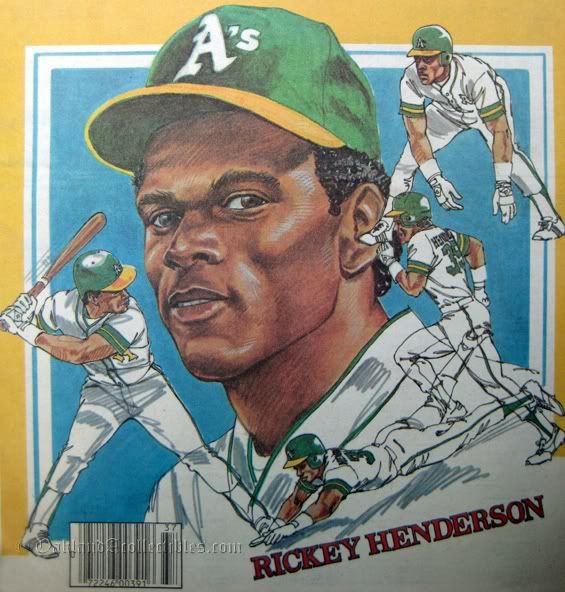
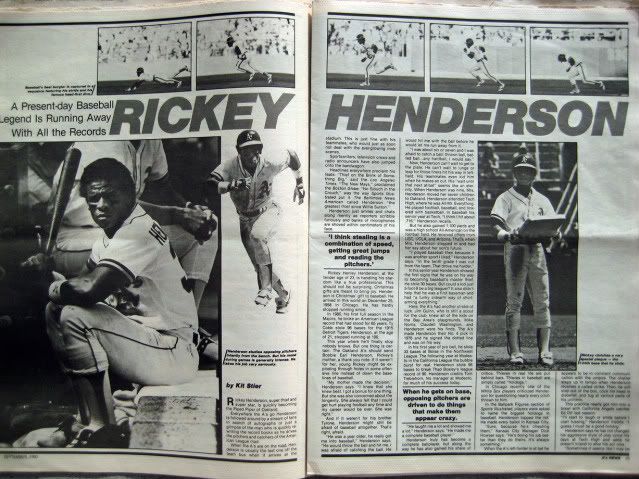
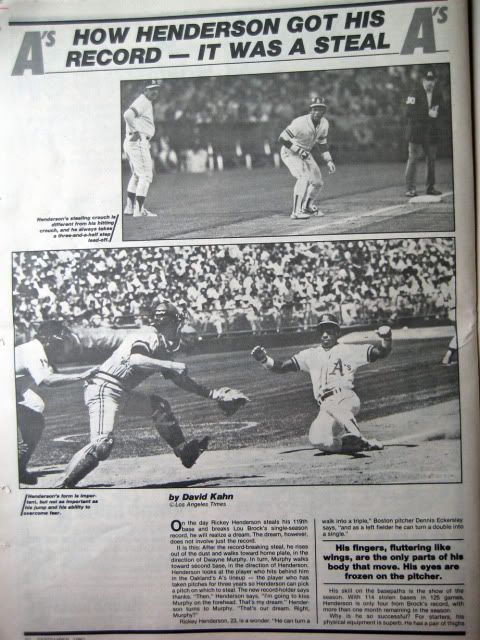
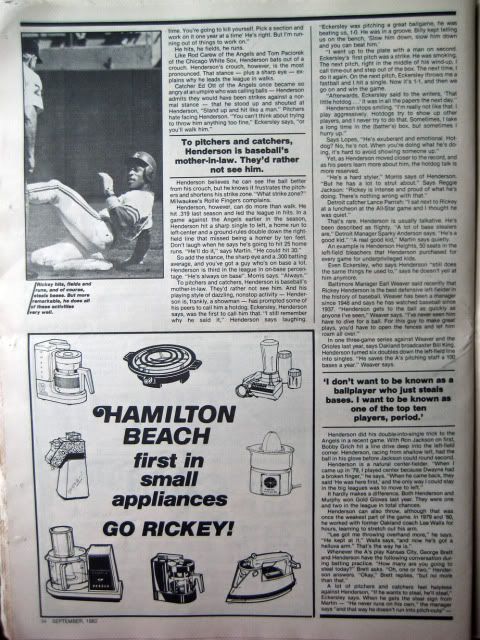
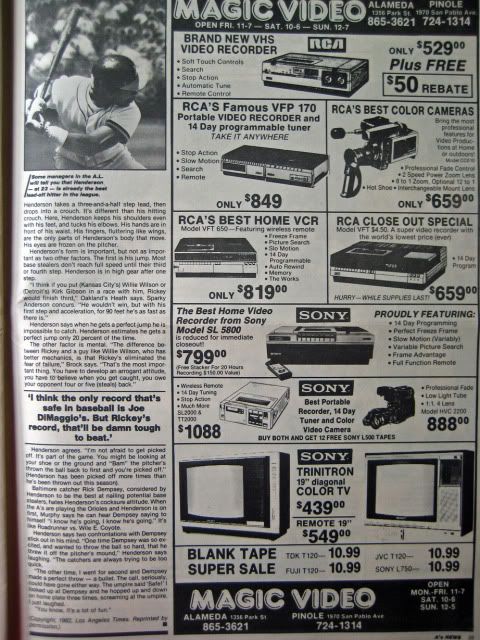
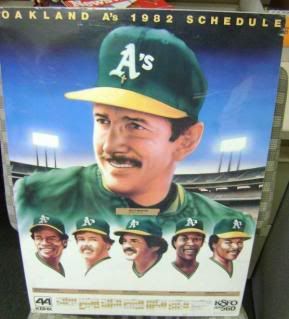
September 1982 A's News Special Edition

A few weeks ago Oakland A's Collectibles posted a special edition of the A's Magazine with a great drawing of Rickey Henderson on the cover. I asked John, who runs the blog, for some more details about the magazine, and he said that the whole issue was dedicated to Rickey! He was nice enough to send over scans of the entire magazine, which I can read, but once uploaded to Photobucket, they don't open up large enough. (If anyone can provide any technical assistance, it would be greatly appreciated). You can at least enjoy the pictures in this great vintage piece of Rickey memorabilia.


Thanks again John!

Wednesday, April 28, 2010

A Few Videos and Some RHC Changes

I'm just now starting to get caught up to the world that is Rickey, after being out of the loop for a few weeks with work, school, and vacation (Hawaii was awesome!). I haven't posted to the site in a little while, but I have been posting much more frequently to the newly created Rickey Henderson Collectibles Facebook page.

I've found that posting quick articles, videos, and comments is much quicker and easier on Facebook than on the main site. If you haven't yet become a fan, please do so, as I don't want any followers to the blog to miss out on anything.

I will still post all of my new card and collectible acquisitions to the site, as well as the random video and article, but most of these will now be reserved for the Facebook fan page.

For those that missed them, here's some of the recent videos that I've posted:


Rickey talks about basestealing and visiting Raley Field, which he compares to Major League stadiums during his early playing career


While working as a roving instructor for the A's, Rickey threw out the first pitch at the Stockton Ports game on April 17th

Wednesday, September 23, 2009

Defensive Indifference

Every once in awhile I come across an article which I find interesting (although most people probably would not), which also has a slight Rickey Henderson connection, but they don't always make it onto the blog. Since this article is about base stealing, and mentions Rickey at the end, I figured it was worth posting.

Keeping score is definitely a lost art, and is a skill that I'm glad my dad taught me when I was younger. It's also something that I hope to be able to pass along to my own son, although it will probably be impossible to find a scorebook when that time comes around.

The following article was in yesterday's New York Times, and discusses the interesting nuance that is "defensive indifference." I knew all about the rule, but I did learn something new in the article. If Rickey was stealing a base (in a defensive indifference situation), and falls down and gets tagged out along the way, he is not stuck with a caught stealing. Since it wouldn't have been a steal in the first place, he can't be punished with a caught stealing, which makes perfect sense, but isn't something that I had thought of before.

Safe at Second, but No Stolen Base to Show for It
by Jack Curry

A player takes an unchallenged lead off first base, dashes to second and makes it safely without a throw. The runner has advanced, but because there was no attempt to thwart him, he does not receive a stolen base. Instead, an official scorer bellows “defensive indifference” in the press box.

Defensive indifference is exactly what it connotes: a situation when a team was unconcerned about preventing the runner from advancing. After official scorers consider the score and the inning, if the pitcher made pickoff attempts and if the first baseman was positioned behind the runner, they determine if the dash was a steal or defensive indifference.

“It’s an old rule and a very good rule,” said Bill Shannon, who has been a scorer for 31 seasons. “I’m loath to give away statistical achievements.”

But what about the runner who has successfully scooted the 90 feet? Some players contend they should be credited with a stolen base. If the team’s defensive strategy was to give away the base, should the runner be rewarded for taking what was available?

“I feel like you should get something for doing it,” said Nate McLouth, a center fielder for the Atlanta Braves. “It’s the only way to advance that doesn’t show up in the stat column.”

Actually, there are statistics for defensive indifference, although they are not mainstream numbers. In a season in which Albert Pujols is approaching 50 homers, Ichiro Suzuki has collected more than 200 hits again and Joe Mauer is batting over .370, only a fan club for official scoring would have a clue how many times defensive indifference has been called this season. The Elias Sports Bureau said there had been 274 calls before Tuesday’s games.

Defensive indifference is a sleepy but established rule that has been in Major League Baseball for 89 years. Bob Waterman, a senior baseball staffer at Elias, said the addendum, “No stolen base shall be credited to a runner who is allowed to advance without an effort being made to stop him,” was placed in the 1920 rule book. The rule is typically enforced in the ninth inning of a lopsided game when the defense yawns as a runner grabs a meaningless base.

It is such a sleepy rule that Carlos Beltran of the Mets, the career leader in stolen-base percentage with at least 200 steals (286 for 324, 88.2 percent), said he did not “even know” what defensive indifference was. Once the rule was explained, Beltran showed that he was aware of it.

“If the first baseman plays 50 feet behind me, there’s no way that’s a steal,” Beltran said. “As a base runner, I wouldn’t want that.”

Still, there are examples of players’ accumulating statistics in other sports because opponents do not defend them. Basketball players go unguarded in garbage time. In football, a team that has a 28-point lead with two minutes left will surrender chunks of yardage.

“That’s football, though,” Yankees outfielder Brett Gardner said. “That’s different.”

Why is it different?

“You’re trying to eat the clock in football,” Shannon said. “We have a linear game. The clock will never eliminate the other team.”

Steve Hirdt, the executive vice president of Elias, noticed references to defensive indifference while researching play-by-play accounts of games from the 1920s. In an article about the imminent rule change in The Chicago Tribune on Jan. 30, 1920, there is a headline that reads, “Cut Out the Joke Steals.” Hirdt called it a good rule because it protects “the spirit of what a stolen base is.”

But Hirdt also noted another situation where players get statistical credit when the opponent is offering something. If teams lead by several runs and the opponent has a runner on third with less than two outs, they do not play their infield in. So teams are willing to give up a run batted in to a hitter, but in those instances, they get an out in return.

Because the runner who goes to second in a defensive indifference situation does not earn a steal, should he be punished if he tumbles and is tagged out?

“You’re out,” the Yankees’ Derek Jeter said.

Marquis Grissom, who stole 429 bases in his career and is now a coach with the Washington Nationals, agreed.

“If you fall down, too bad,” he said.

Not really. Hirdt noted that Rule 10.07(h) states that a runner cannot be nabbed with a caught stealing if he would not have been credited with a steal if he had been safe.

Shannon estimated that he calls defensive indifference about a dozen times a year. When Shannon called it with Rickey Henderson as the base runner more than 20 years ago, a Yankees public-relations official complained. Shannon told the man he would change his call if Henderson finished with 999 career steals. That was Shannon’s way of saying he was never altering his call.

“Achievement,” Shannon said, “is not a gift.”

Thursday, July 23, 2009

Rickey Henderson Articles

As would be expected, there have been quite a few articles written on Rickey lately, and I've included links to some of the most interesting ones here. I'm putting this list together as I sit in the Sacramento airport, waiting for my plane to arrive to take me to New York (which is unfortunately almost an hour late).

Rickey Henderson is His Mother's Pride and Joy - Rickey Henderson's mother Bobbie had always wanted a girl, and even though she had Rickey, she couldn't be happier.

Baseball's Haul of Fame - Although Rickey's legacy had already been forged, there are quite a few less famous Hall of Famers (Goose Gossage, Gary Carter, Ryne Sandberg, etc.) who have benefited greatly (ie financially) as a result of their inductions into the Hall.

Rickey to be Rickey at Hall Induction - MLB.com recently interviewed Rickey about his induction speech, which is arguably the most anticipated induction speech ever.

Henderson's '#1 Fan' Hallbound - No, this article isn't about me, but a 25-year-old named Erin who was known to bring different signs to the Oakland Coliseum in the hopes of catching Rickey's attention, which she was very successful at doing.

I'll post more Rickey articles as I run across them. There's plenty of articles chronicling his career and his Hall of Fame induction, but I'll try and link to some of the ones that are more interesting and unique.

Friday, June 19, 2009

Is Rickey Upset With the A's?

I recently came across a story written by Monte Poole of the San Jose Mercury News, that I found both interesting and a little sad. It seems that Rickey hasn't been on very good terms with the Oakland A's over the past few years, and is a little upset over the way that he has been treated. He says that if it weren't for the fans, and the fact that Oakland is his hometown, he'd like to go into the Hall wearing a....Padres hat! Which is just blasphemy if you ask me!


Although he broke both the all-time runs scored and walks records while playing for the Padres, it's definitely not the team with which he's most associated.

The whole story can be found below, as well as at this link.

Six weeks from today, Rickey Henderson will be the toast of baseball, a first-ballot inductee into the Hall of Fame, standing at the podium wearing an A's cap.

And having decidedly mixed emotions about the organization that cap represents.

Henderson's decision to go green and gold in Cooperstown is complicated by the perceived sheet of ice between the club and the greatest — and most popular — player in franchise history.

"I'm doing it for the fans, for the city, because this is home," Henderson says. "If (Oakland) wasn't home, I don't think I would wear it. Because I don't feel the love."

Rickey being Rickey? Maybe. But Rickey has a point.

He has not felt the love from his original team for a long time. Drafted by the A's out of Oakland Tech in 1976, Henderson spent 14 of his 25 major league seasons with the A's. He served four stints, under three ownerships, for six managers, the last being Art Howe in 1998.
In the decade-plus since, Rickey and the A's have shared one thing.
Distance.
It's as if there is a door to the organization through which Rickey can look but not enter.

Though Henderson is always welcome at the ballpark, there has been no sincere invitation to lure him back as a player, coach or as a highly visible community ambassador. Not until this month did the A's reach agreement on a personal services contact with Rickey, allowing him to make appearances on behalf of the team in 2009.

The A's say there are plans to do more in the future.

"I'm sure there will be further discussion to determine a role for Rickey beyond this year," Ken Pries, the team vice president in charge of several areas, including community relations. "We realize how much Rickey means to our heritage."

The roots of Rickey's bittersweet emotions likely lie in the failure to finish his playing career with the A's. His final seasons as an active player were spent with the New York Mets, Seattle Mariners, San Diego Padres, Boston Red Sox and Los Angeles Dodgers — in addition to the Newark Bears and San Diego Surf Dawgs of separate independent leagues.

All the while, even as late as 2006, Henderson sought to leave baseball wearing Oakland's green and gold. His very public pleas for one last chance to enter the batter's box in an A's uniform, heard 'round the baseball world, gained no traction within the organization.

It became an annual issue, local A's fans approaching general manager Billy Beane in coffee shops and parking lots, asking if Rickey might return for a grand finale. Most had heard that Henderson was willing sign any contract — even a minor-league deal— for the opportunity to prove his worth.

Nothing budged.

Though Beane consistently said he understood the desires of the fans, he also was consistent in saying he was trying to build a team with youth and a few selected veterans who could fill specific needs. Rickey, he always said, was not the right veteran to address those needs.

In his last overture, Henderson offered to donate his entire salary to charity. He yearned only for the chance to make the team, insisting he would pack up and go home if it were determined that he was unworthy. Practically begging, Rickey even took his plight to HBO's Bryant Gumbel.

Still nothing.

And not much in the last couple years, either, as it became apparent Henderson's playing days were over. He accepted invitations from the Mets to come to spring training to teach his considerable baserunning skills. He even spent time as a first-base coach.

The A's clearly have moved on.

"I would have been happy to work with Ron Washington when he was here," Henderson says, "or maybe come to spring training for a week or two and work with the younger players."

Having played for seven other teams, Henderson has seen the treatment other stars get from the organizations with which they are most identified. He knows of Tony Gwynn's iconic status in San Diego, knows what Minnesota thinks of the late Kirby Puckett.

Which makes it all the more painful to Rickey that he can't seem to reconcile with his hometown team. The team with a hold on his heart.

"I'm right here," he says. "I spend most of my time around here, right under their nose. I got my arms open to 'em."

Part of Rickey wishes he were courageous enough to take a hard stand. If he could, he would wear a Padres cap, he says, because he feels a mutual respect and appreciation.

But there's no chance of that. Rickey is committed to wearing an A's cap. It's in his blood. Even if there are times when he wishes it weren't.

Tuesday, June 2, 2009

Rickey the Teammate

Although the general public tends to think that Rickey cared only about Rickey, most of those that played with him actually think otherwise. Among baseball circles, Rickey was actually a pretty good teammate, and he has no shortage of fans among those that he played. The following story, by Wayne Hagin of WFAN in New York (and ex-A's broadcaster), is one that I had never heard before, but that definitely bears repeating. The source for the story can be found here.

Rickey Henderson will get his coveted spot in Cooperstown later this summer. Voted in on the first ballot, Rickey, arguably, is baseball's greatest leadoff hitter. While the stolen base records as well as others such as leadoff homers may never be toppled, it is Rickey Henderson, the character, that we won't soon forget!

Rickey had a way of speaking in the third person and in my early days as a broadcaster with the Oakland A's, he would simply repeat my question as his way of answering what I had just asked. No matter what the feat, Rickey would provide an interesting pre or post game show and never said no. I remember 1982 as if it were yesterday when Rickey stole his 119th base and broke Lou Brock's single season mark. The record was established in Milwaukee and Hall of Fame announcer Lon Simmons, my partner in the booth at the time, told a very young Wayne Hagin to put on my headset and get ready to "call" the record breaker when Rickey got aboard at first. I knew why Lon was offering me that opportunity and I was grateful. Lon Simmons felt he had made several big calls in his major league career already and wanted a young broadcaster to have his "first" big call. I was stunned by his generosity but simply declined by saying on the air, "only one man deserves to call this moment and he's at the microphone right now". I put down my headset and walked to the back of the booth and listened to history being made on the next pitch. Lon called it beautifully and that call is now in the archives of baseball radio history!


I also remember a night in Kansas City that same season of 1982. This is a Rickey Henderson story that very few people know about. Being a single man my first four years of broadcasting major league baseball meant that I took in the "sights" on the road. Quincys was the name of the bar downstairs in the Kansas City hotel where most visiting teams stay. It was closing time and that meant that I was going to walk up the stairs to the lobby and catch the elevator and retire for the night. I was walking up the stairs next to Brian Kingman, one of the A's starting pitchers. Infamous for losing 20 games two years before, there was a constant friction between A's manager Billy Martin and Kingman. Little did I know, that I would be thrust into that friction within seconds of reaching the hotel lobby. At the top of the stairs stood Billy , with that black cowboy hat he was so fond of wearing . Standing with him were his coaches. I whispered to Kingman, "what is that about"? As we approached the top step, Kingman told me that Billy was waiting for him! Billy simply did not understand the cerebral Kingman and the two had knocked heads about his pitching style, effort, and results. Now, they were going to knock heads literally. When we had reached the Martin party of five, waiting like vultures for Kingman, the words started spewing. After several minutes of verbal jabs, Billy stated that they were going outside to rumble. I pleaded with Billy that he didn't want to do this and he told me to step aside. This was going to happen and happen right now.

Billy always had his coaches by his side. We all know why. Billy stepped outside the hotel and into the warm, humid Kansas City night. Brian Kingman would walk through the same door, knowing that fight time was near. Then, something happened that I will never forget. As the two men exited through the door, one of Billy's coaches stood at the door and blocked anyone else from joining in. Billy and his four other coaches were outside with Kingman with this other coach making sure there was wasn't any backup. What you need to know is that several of the A's players were in that lobby when this unfolded. Only one player went to the door to aid his teammate. When that player got to the door, the coach said ," You don't want to get involved". That player said that if Billy had his coaches outside then he needed to provide support for his teammate.

That player was none other than Rickey Henderson! While the other players turned their heads and , in essence, their backs on Kingman, it was Rickey, the star of the team, who went outside to be a peacmaker. Billy and Brian did scrap and yes, there were some pretty good punches thrown between the two. It was ruled a draw and the miserable 1982 season would end with Billy being fired during the World Series. I will always remember Rickey Henderson that night because he was the sole player to challenge what was happening between his manager, coaches, and his teammate. Rickey felt Kingman was outnumbered and went to his rescue. I know Rickey Henderson will be remembered for a lot of things during his time in the big leagues. Some of it funny, some of it historical. What I will remember is his courage to stand up for a teammate and try to right a wrong.

For that he will be remembered!

Friday, January 2, 2009

Rickey in the Newspaper

I know I'm a little late in posting this, but better late than never. With the Hall of Fame induction results coming out shortly, interest in Rickey has definitely be picking up. What a nice surprise it was to open up my local paper (the Sacramento Bee) the day after Christmas, and see a nice big picture of Rickey on the inside of the sports page.


Since the font of the article is a little small (you can read it if you click the picture), here's a link to an expanded version of the same article (originally published in the Contra Costa Times).

It's been many years since I've actually read an article about Rickey in the daily paper, and it was kind of fun. There will naturally be plenty more articles in the near future, with his impending induction into the Hall. If any readers out there happen to see any commemorative Rickey pull-outs in their local paper, please don't hesitate to let me know. I'm expecting that Rickey Henderson memorabilia will pick up in the coming months, and I don't want to miss out on anything cool!

Wednesday, December 31, 2008

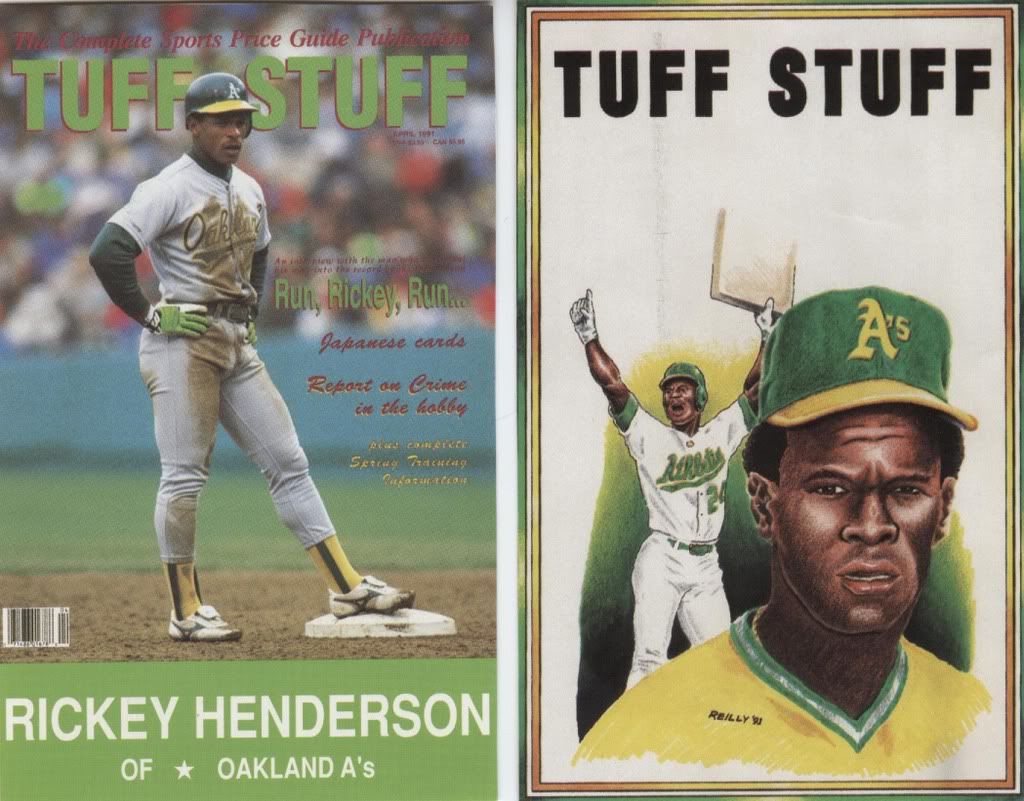
My Interview With Tuff Stuff

I was contacted about a month ago by a writer who asked if I was interested in doing an interview for a Rickey Henderson article that he was writing. Of course, I jumped at the chance, excited that my little blog about Rickey was getting some sort of recognition. We talked for about 20 minutes on the phone later in the week, and followed up with some more questions via e-mail.

The author is a freelance writer working for Tuff Stuff, with the article going to run in the February issue (to be released in mid-January). I was then pleasantly surprised yesterday, that while doing some "Rickey research" online, I came across the article! I guess Tuff Stuff "prints" the articles online a little before the newsstand issue is released.


Here's a direct link to the article on Tuff Stuff, as well as the same article on Sports Collectors Digest (with the only difference being the title). I didn't realize until yesterday that they were both owned by Krause Publications, and can therefore share resources. The print article should be very similar, with only the addition of a few more pictures, with some of them hopefully being ones that I submitted.

Below is the full text of the article, with the parts discussing the blog highlighted in green:

Head of the Class: Henderson Hall bound
December 17, 2008


By Kevin Glew

Rickey thinks Rickey is a Hall of Famer. At least, that’s what baseball’s stolen base champ would likely say about his Cooperstown chances. And it would be difficult to argue with the fleet-footed superstar who often talks about himself in the third person.

Before Manny was being Manny, Rickey was being Rickey. Though he hasn’t officially retired, Henderson is eligible for the Hall of Fame for first time in 2009. And when the new induction class is announced on Jan. 12, it’s expected that Henderson will be a near unanimous selection.

The 10-time All-Star is baseball’s all-time leader in stolen bases (1,406), runs (2,295) and leadoff homers (81). A member of the exclusive 3,000-hit club, Henderson also owns the record for most stolen bases in a season (130 in 1982). Add in an American League MVP award (1990), 297 career round-trippers and three Silver Slugger awards (1981, 1985, 1990) and you’ve got yourself a Hall of Fame resume.

“Without a doubt, he’s the best leadoff guy in the history of the game,” said Dave McKay, a former A’s teammate, who also coached Henderson in Oakland. “He was just such an impact player.”

Longtime Toronto Blue Jays third baseman Rance Mulliniks, who played against Henderson dozens of times, agrees.

“He was without a doubt the most dynamic, unstoppable offensive force I’ve ever played against,” he said.

Dan Shulman, baseball play-by-play announcer on ESPN, shares similar sentiments.

“He’s an automatic first-ballot Hall of Famer, and I’d imagine he’ll get at least 95 per cent of the vote. He was as unique a weapon as there was in baseball for a long, long time,” he said.

Of course, along with his stupendous talent, Henderson was also a controversial figure. His patented snap catches drew the scorn of baseball purists, who labeled him a hot dog. But if you read Henderson’s biography, Off Base: Confessions of a Thief, you’ll discover that Henderson viewed himself as an entertainer and the catches were part of his act. And to Henderson’s credit, he won a Gold Glove in 1981 while still perfecting his snap catch.

But even Henderson has expressed regret about his remarks after he broke Lou Brock’s all-time stolen base record on May 1, 1991. Speaking to the crowd with Brock on hand, Henderson declared, “Lou Brock was the symbol of great base stealing. But today, I’m the greatest of all time.”

“People gave him a hard time after that speech, but he gets a bad rap for that. He really was the greatest base-stealer of all-time. That can’t be disputed. Maybe he shouldn’t have said it, but I don’t mind it,” said Perry Andrews, a longtime Henderson fan and card collector.

Actions like these are what have made Henderson one of the most colorful characters in baseball history. They also help to explain his strong collector following.

“People that collect him really have a passion for him,” said Jim Kramer, owner of Southpaw Cards in Roseville, Minn.

Matt Taylor, owner of the top Henderson basic set on the PSA Set Registry, is one such collector.

“He’s the best leadoff hitter of all-time. He was definitely one of my favorite players when I was a kid, so that’s where I started with the collection,” he said. Andrews has created a website dedicated to his Henderson collection (www.rickeyhendersoncards.com). Brad Abbott was similarly inspired. His online shrine (www.rickeyhendersoncollectibles.com) has been up and running since January 2008.

“Despite the reputation that he has gained over the years, I admire Rickey’s determination and desire. All he wanted to do was play baseball, and he’d play for whoever would let him. He knew that his job as a leadoff hitter was to get on base and score runs, and he did everything in his power to make that happen. He was a lot of fun to watch,” said Abbott.

One of the toughest Henderson cards to track down is his 1977 Chong Modesto A’s minor league single (#5). Released as part of a 23-card team set, this single showcases Henderson’s first name spelled “Ricky.” A 1977 team set that included a PSA MINT 9 (OC) Henderson sold for $1,321 in an American Memorabilia auction in September 2007.

The most renowned Henderson card, however, is his 1980 Topps rookie (#482).

“That’s the Holy Grail of the Rickey Henderson collector,” said Taylor.

Hampered by centering issues and focus problems, this card is one of the toughest modern rookies to uncover in high-grade. Of the 9,186 submitted to PSA (as of press time), just 10 have received the vaunted PSA GEM MINT 10 grade. One PSA 10 example sold for $4,264 in a Mastro Auctions sale in April 2007.

Collectors must also be wary of counterfeit Henderson rookies. Differences between the fakes and real cards can be viewed on Andrews’ website. Andrews says that counterfeits boast discernible tiny dots in the background on the A’s banner, while this area is a solid color on authentic examples.

Autographed Henderson items are also highly coveted. Larry Studebaker, a longtime autograph seeker and now an authenticator at James Spence Authentication, says Henderson has become a tough in-person autograph.

“Between 1980-90, he was much more obtainable,” said Studebaker. “I’ve never gotten him to sign anything in person. And I’ve asked him like 20 times.

He has the real deep, scratchy voice and he always says, ‘Rickey don’t sign.’ ”

Studebaker has also seen his share of bad Henderson autographs.

“A lot of times on Oakland A’s balls or New York Yankee balls, the whole ball is completely signed by each individual on the team, then you get to the Henderson signature and it’s a clubhouse signature,” he said.

At one point, a New York company named Man of Steal Sports, Inc. seemed to be the primary source of Henderson autographed items. However, this company’s phone number is out of service and their website is no longer functioning, so it appears they have closed.

Mitch Adelstein, president of Mounted Memories, has had Henderson as a guest at a Chicago Sun-Times show. His company boasts a significant inventory of Henderson items. He says signed baseballs have been his best-selling Henderson items, followed by autographed pictures of Henderson hoisting the base after he broke Brock’s stolen base record.

Despite the pending Hall of Fame announcement, however, hobby dealers say there hasn’t been a big rush for Henderson collectibles.

“There’s not much demand for him at all,” said Monty Delong, owner of CJ’s Sports Cards and Memorabilia in San Diego, Calif.

Jim Bernardini, co-owner of Lefty’s Sports Collectibles in Burlingame, Calif., has had a similar experience.“I don’t think I’ve had anybody ask for one of his items in months,” he said.

Even Ken Brison, owner of Talkin’ Baseball in Danville, Calif., a store that many A’s fans frequent, hasn’t seen an increase in interest.“With the state of the economy, nothing’s extremely hot, but Rickey is well-received here,” he said.

There’s not much demand for Henderson cards on the East Coast either. Steve Bistany, owner of Steve’s Sports Card, Coin and Stamp Shop in Rutherford, N.J., says no one asks him about Henderson cards.

“There’s not too much activity in his name anymore,” he said.

But most dealers expect a spike in demand after the Jan. 12 announcement.

“There will be requests because we have our standard amount of customers that collect Hall of Famers,” explained Bernardini.

Chris Console, managing director at Steiner Sports & Entertainment Marketing in New York, concurs.

“From a collectibles standpoint, you’re going to see a new wave of collectors after Rickey becomes a Hall of Famer,” he said.Hobbyists can also expect to see more Henderson cards on eBay.

“Once Rickey is announced as being inducted, you will see a ton of his cards flooded into the market. There will be an uptick in the price of his rookie card, as well as the prices on some of his scarcer cards,” said Abbott.

Adelstein hopes to set up a signing with Henderson in the new year. However, collectors should buy their Rickey autographs prior to the induction announcement if they want to save money.

“If you wait (until after the Hall of Fame announcement), prices are obviously going to go up. It’s just how our business works,” said Adelstein.

Abbott is so confident that Rickey will be enshrined in Cooperstown that he has already reserved a hotel room for the 2009 induction ceremonies.

“My goal is to finally meet Rickey, get him to personalize an autograph, and hopefully introduce him to my site,” he said.

If things go as expected, Abbott will be in a good place to achieve his goal. And for us media types, we can’t help but look forward to Henderson’s induction speech. We love to hear Rickey talk about Rickey.

Friday, October 10, 2008

The Science of the Slide

David Peters, and engineering professor at the University of St. Louis, has just released a study determining that the head-first slide gets the ballplayer to the base faster than the feet-first slide. Looks like Rickey did know what he was doing after all! The press release can be found here, but is also reproduced in its entirety below.


Base running and base stealing would appear to be arts driven solely by a runner's speed, but there's more than mere gristle, bone and lung power to this facet of baseball — lots of mathematics and physics are at play.

With baseball playoffs heating up and the World Series right around the corner, it's guaranteed that fans will see daring slides, both feet-first and head-first, and even slides on bang-bang plays at first.

Who gets there faster, the head-first slider or the feet-first?

The head-first player, says David A. Peters, Ph.D., the McDonnell Douglas Professor of Engineering at Washington University in St. Louis, and big-time baseball fan. He says it's a matter of the player's center of gravity.

Peters is a mechanical engineer who specializes in aircraft and helicopter engineering. He sees "fields of dreams" a bit differently than most — he sees them as playgrounds of math and physics.

Peters says that dynamics equations can determine which slide gets you there more quickly, and that there are three important mathematical issues at play.

"There's momentum — mass of the body times how fast the player is moving," he says. "There's angular momentum (mass movement of inertia times the rotational rate). If it's feet-first and you're starting to slide, your feet are going out from you and you're rotating clockwise; if it's head-first, as your hands go down, you're rotating counterclockwise."

"On top of this is Newton's Law," Peters explains. "Force is mass times acceleration. Then moments of inertia times your angular acceleration."

So, who gets there faster?

"It turns out your center of gravity is where the momentum is," Peters says. "This is found half way from the tips of your fingers to the tips of your toes. In the headfirst slide, the center of gravity is lower than halfway between your feet and hands, so your feet don't get there as fast. It's faster head-first."

For a long time — until roughly the Pete Rose era of the '60s and '70s — players shunned the headfirst slide to protect their hands and faces. Spikes, evoking the Ty Cobb days, were weapons on the diamond. In the past few decades, players who prefer the head-first slide have taken to running while holding onto their batter's gloves to prevent their hands from opening up and being exposed to injury. While the percentage of players who slide one way or the other is not actually known, Peters estimates it's about 50-50.

Peters notes a growing number of players who will slide into first base, despite conventional wisdom that running through first is the faster way.

"Mathematically, you might think there's an advantage, but leaving your feet is actually a detriment because you're no longer pulsing (pumping your legs) and you start to decelerate," he says. "When you're running, your get your feet out in front of the center of gravity, so you're getting maybe three or four steps of an advantage."

Peters says the only advantage of any slide into first base is to avoid the first baseman's tag when he has to come off the base to spear an errant throw.

"In general, most agree to run through first, but you'll find people who will swear it's better to do it the other way."

Source: Washington University in St. Louis (2008, October 1). Baseball: Head-first Slide Is Quicker. ScienceDaily. Retrieved October 10, 2008, from http://www.sciencedaily.com? /releases/2008/09/080926120520.htm